
Guatemala has rejected Belize’s account of a Guatemalan military aircraft incursion into Belizean airspace, telling the United Nations General Assembly that the reported flight did not occur and challenging Belize to submit the matter to the established verification mechanisms between the two countries.
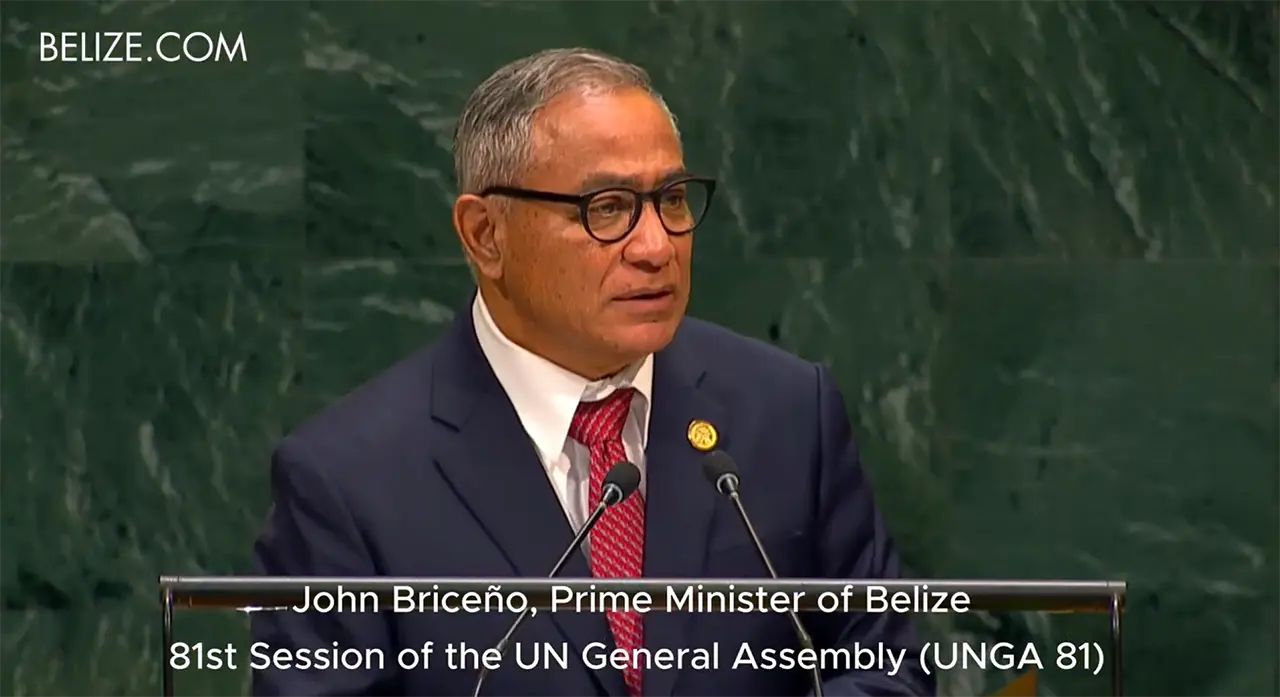
The response came after Prime Minister John Briceño used Belize’s address to the 81st UN General Assembly on September 26 to accuse Guatemala of a serious breach of international law. Briceño said a Guatemalan military aircraft entered Belize’s sovereign airspace on September 24 and intentionally disabled its transponder. Belize has described the incident as an unauthorized incursion and called for increased monitoring by the United Nations and the Organization of American States (OAS).
In its Right of Reply, Guatemala flatly disputed Belize’s version of events. The Guatemalan delegation characterized the reported incident as a “supposed” overflight and rejected what it described as misinformation surrounding the aircraft’s movements. Guatemala said it would formally ask the OAS Office in the Adjacency Zone to investigate the incident and indicated that it was prepared to provide flight records and make the aircraft available for inspection.
The exchange now puts the focus squarely on evidence and verification.
Belizean officials have said they have information supporting their account of the incident. Foreign Affairs Ministry CEO Oscar Arnold said Belize intends to provide Guatemala with information gathered by Belizean authorities, including locations and GPS coordinates, and to issue a formal diplomatic protest.
Guatemala, meanwhile, has maintained that its military operations are conducted in accordance with national and international law. Guatemala’s Ministry of Defence initially issued a statement after reports emerged in Belize, saying that all operations of the Guatemalan Army are conducted in accordance with the applicable legal framework. Guatemalan media subsequently reported that the ministry said it had no record of the alleged overflight.
The OAS mechanism now comes into focus
The dispute is particularly significant because Belize and Guatemala already have a mechanism designed to deal with incidents arising from their longstanding territorial dispute.
The 2005 Agreement on a Framework for Negotiations and Confidence-Building Measures established the OAS-supported process between the two countries. The OAS Office in the Adjacency Zone has played a central role in helping verify incidents and maintain confidence between Belize and Guatemala.
The two governments reaffirmed that framework as recently as June 2026. In a joint declaration issued at the OAS General Assembly, Belize and Guatemala reaffirmed their respect for sovereignty, territorial integrity, international law and the peaceful settlement of their dispute. They also specifically recognized the continuing role of the OAS Office in the Adjacency Zone and called for continued implementation of the 2005 confidence-building measures.
That makes an independent examination of the aircraft incident particularly important. If Belize’s evidence establishes that the aircraft entered Belizean sovereign airspace without authorization, the matter would represent a serious issue for Belize’s territorial sovereignty. If Guatemala’s position is correct and the reported flight did not occur as described, the evidence should establish that as well.
A dispute unfolding as the ICJ case moves closer to hearings
The latest confrontation comes at a sensitive point in Belize-Guatemala relations. The territorial, insular and maritime dispute is before the International Court of Justice, with oral hearings scheduled for February 22-26, 2027. Guatemala has continued to publicly emphasize that it will abide by the eventual judgment.
For Belize, the issue is therefore not simply about one aircraft. The government has linked the alleged overflight to broader concerns about actions by Guatemalan state personnel and vessels in and around Belizean territory, including the Sarstoon area. Briceño told the UN that Belize wants the dispute managed through international law and confidence-building mechanisms rather than through actions that could heighten tensions.
For Guatemala, the response at the UN was an effort to put its own version of events on the international record and to insist that disputes between the two neighbors should be handled through established bilateral and OAS mechanisms.
The immediate question is now straightforward: what do the flight records, radar information and other available evidence show?
With both governments offering sharply different accounts, the OAS Adjacency Zone process provides an existing channel through which the competing claims can be examined. For Belize, the priority will be ensuring that its sovereignty is protected and that any alleged violation is properly documented. For Guatemala, the challenge is to substantiate its assertion that the reported flight never happened.
The facts surrounding the aircraft’s movements should ultimately matter more than the competing statements made in New York.